

As guitarists, we all know the joy of listening to our instrument scream through an amp that’s turned up to 11.
Yet, at some point, I think we all have the same thought: what does music sound like through a Marshall stack?
Can we use our amps as a normal speaker? If you’re just wondering if it’s achievable or not, the short answer is yes, absolutely. The longer answer, however, is a bit more nuanced.
Table of Contents
Purpose of Guitar Amps

I think it’s important that we first understand why we use guitar amps specifically and not just any normal speaker.
Put simply, guitar amps are made specifically for guitars. Amps are designed to strengthen the weak electrical signal from a guitar’s pickup and convert it into sound through a loudspeaker.
These loudspeakers are also designed to be durable enough to output loud volumes for prolonged periods and years on end. This is to prevent the amp from running into sound issues or the speakers being blown out.
There is also the matter of frequency range. Guitar amps are designed more for the midrange of frequencies (70Hz – 6kHz) as this is where a guitar performs best. Bassier than that, you’d be looking at even lower frequencies, and more trebly means the opposite.
This is also why we get amps specifically for bass guitars, as those are designed for the lower range of frequencies (20 – 300Hz).
Purpose of Regular Speakers
Speakers, like the ones in a home theater system or a Bluetooth travel speaker, are sort of the opposite of an amp.
Speakers are designed to cover a very wide range of frequencies, from low to high. They generally cover the whole range of human hearing (20Hz – 20kHz), but really high-end ones can go below and above that range.
The reason for this is because they have to produce the sounds of multiple instruments, as well as vocals, that span the whole range of frequencies. They also have to sound good.
Let me tell you an interesting story. Once I was listening to an interview of a famous local singer, who’s known for introducing experimental sounds and making them common in songs. I’m talking about sounds of things like crows cawing, insects making weird noises, tires screeching, rainfall on an uncommon surface, etc.
Now think about this, if such sounds were routinely implemented into album songs, how flexible would your speakers need to be in order to reproduce them somewhat accurately? Forget guitar amps, even cheap everyday speakers won’t cut it, and you’d probably be missing your headphones or studio monitors to get the real feel of those songs.
Why Not Use an Amp as a Speaker
There are two main reasons not to use an amp as a speaker.
Because they’re not designed for it, you’re not going to get the same quality of sound. Music is going to sound a bit muddy and distorted, and some frequencies are going to be cut out.
Let me share a real example with you. On our special day, I was out with my wife on a romantic getaway. It was a fantastic romantic retreat in Colorado Springs with a private hot tub that I found through TubInRoom (I keep going back to it for other locations every now and then 😉 ). I had the Blackstar Fly 3 amp in my backpack, and my Yamaha travel guitar in my car.
Unfortunately, I left the bluetooth speaker at home. To set the mood in our jacuzzi suite, I tried playing music through the Fly 3 amp, knowing very well that it lacks any kind of a FRFR (full-range) speaker, and tell you what, it was such a huge disappointment! It completely failed to reproduce much of the entire frequency-range of the kind of music we were playing.
Beyond this, the biggest downside, for me at least, is that amps are mono.
That means that you won’t be listening to any stereo songs, and since stereo recording is the norm, you’ll be missing out on a lot.
I think you can see the problem we run into trying to play music through an amp. The fact is that amps aren’t designed for it.
Yes, you can definitely use an amp as a speaker, but your experience might not be that great.
How to Use a Guitar Amp as a Speaker
Even though guitar amps weren’t designed to be used as speakers, that doesn’t mean you can’t.
There are a few ways to use an amp as a speaker, and a few things to keep in mind.
Built-in Aux Inputs
Many modern amps come with a built-in aux input. Usually located at the back of the amp or at the front like on the Fender Champion 40.

Adapters
If your amp doesn’t have a built-in aux input or buying a new amp isn’t really an option, then you can use an adapter.
You can get a 3.5mm to ¼-inch adapter for really cheap and they’re pretty easy and reliable. Just plug your phone’s 3.5mm audio jack into the adapter and the adapter into your amp’s input.
You can also connect your computer using a 3.5mm to 3.5mm cable and adapter.
These adapters also come in a reverse ¼-inch to 3.5mm configuration.
Multi-effects Pedal
Some multi-effects pedals, like this Boss ME-80, also come with built-in aux inputs.
The upside of using a pedal as your aux input is that the pedal will be able to better process both the guitar and the music audio.
This is very useful if you’re planning on jamming along with the music or practicing with backtracks.
Amps with Full Range Speaker
This is perhaps the best, and of course the most expensive option.
Using an amp that has built-in full-range speakers is certainly a good option. These amps come with speakers for the specific purpose of playing back music.
This extra bit of convenience does unfortunately come at a bit of a premium. Amps with full-range speakers, like this one from Line 6, cost slightly more than your usual amps. But it is a nice convenience to have nonetheless.
This amp cabinet even has Bluetooth, so you don’t even need extra cables.
Headphones
As an alternative to using your amp as a speaker, headphones are a good option.
Many amps have dedicated 3.5mm headphone outs. Even budget ones like this Fender Mustang LT25 has this option.
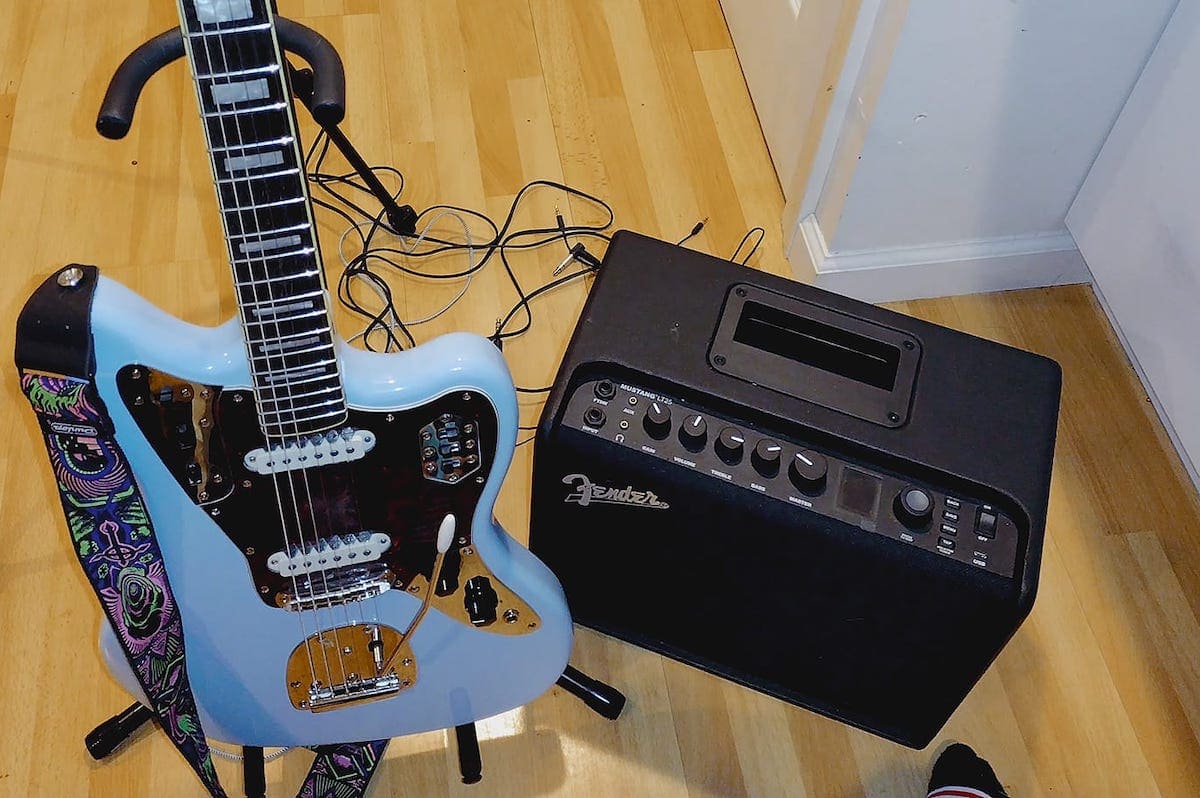
This is definitely a good solution if you want to practice and it’s late at night or you can’t really push the volume on your amp for any other reason.
Risks
So, we’ve established that you can use your amp as a speaker. We’ve also gone over some ways of doing that. There are, however, still a few things to keep in mind.
Although not dangerous, there is still some risk to using your amp as a speaker. Because guitar amps are only designed for midrange frequencies, frequencies outside that range can be harmful.
Low frequencies, especially in bass-heavy music, can spell trouble. Playing bass-heavy music at high volumes can rip the amp’s cone.
High frequencies on the other hand can cause popping, which can also lead to damage.
Precautions
With all this in mind, there are a few ways to minimize the risk of damaging your amp.
Set the Volume Low
It is very important not to use the amp at full volume.
So, when you’re setting up the amp, plug in the audio source while the amp’s volume is turned all the way down.
Start playing a song and then slowly turn up the volume. Also, be sure to keep the source’s volume as low as possible.
I wouldn’t go past 5 on the amp’s volume. Any higher and you’ll risk damaging the amp.
Adjust the EQ
As I mentioned, low and high frequencies are a bad idea. So, just like the volume, keep the bass and treble on your amp as low as possible.
Avoid using any overdrive or gain. It’s best to just keep that turned all the way down. Also, you can adjust the bass and treble on the software or app you’re using to play music.
Use Only the Clean Channel
This is really just so that you get the best sound. Stick to the clean channel, using the overdrive channel is just going to make the audio very muddy and not at all pleasant to listen to.
Use Only for a Short Period of Time
Try to limit using the amp for no more than 30 minutes. Any longer and you might notice the sound become more distorted.
This should keep your amp healthy.
Use Open Back Cabinets
If you have the choice between an open back and closed back cabinet, go open back.
Open back cabinets tend to produce less bass, and as we know, less bass equals less risk of damaging your amp.
Conclusion
The takeaway here is that you can absolutely use a guitar amp as a speaker for playing music, but the drawbacks are just too much for it to be worthwhile. Unless, of course, you already have a guitar amp with a full-range speaker.
If you do decide to try, and I do think it’s an interesting experiment, I hope I’ve given you enough advice and information to get the best possible experience.

My question is can I hook up a microphone in the auxiliary to sing while playing the guitar.
What’s the best wattage for a small village hall/community centre, please, if providing music for a small dance troupe for two hours per week? It would be fed from a laptop line,out and a reasonable level bass is needed.
Thanks!