

From adding air as a room microphone to recording claps, screaming, cheering, choirs, and well, decades of monophonic recordings, omnidirectional microphones are a golden studio trick for producers.
Nowadays, with lavalier microphones on the laps of some of the biggest speakers in the world, influencers, reporters, and much more, omnidirectional microphones have left the studio and taken over the world.
Yet, when you set out to buy your first, you’re met with an avalanche of options, giving you analysis paralysis and forcing you to postpone the purchase until you can figure it out.
Worry not, I handpicked the best options in every field and budget to transform your recordings, performances, and public appearances for the better and for good.
Let’s do it!
Best Omnidirectional Mics - My Top Picks
1. AKG P420
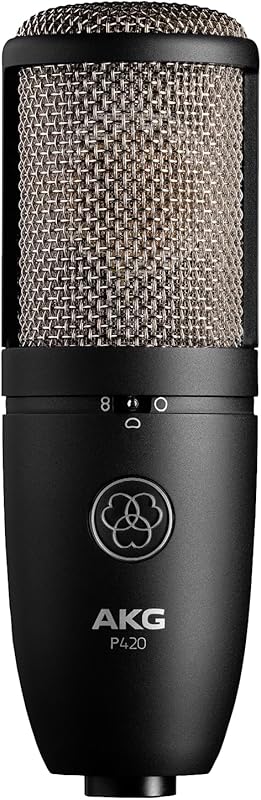
AKG is one of the biggest names in the microphone world. It’s given us timeless classics you come across daily in studios, like their 414.
Well, borrowing from that legacy and know-how, the company developed a more affordable line of microphones for home studios, hobbyists, and beginners. Let me tell you that this thing has got the AKG DNA in it, delivering surprising audio quality for the price.
To be honest with you, I was expecting to find the overly bright, character-lacking, undefined tone of any other condenser in this price range. However, I found this mic to be a pleasant surprise. There’s cleanness and an openness to the higher midrange that’s airy and nice instead of being brittle or harsh.
Furthermore, the P420 can withstand 157dB of SPL, which makes it usable to record just about anything.
I just loved it as a ready-to-track microphone. The kind you can have on your workstation, always plugged in and ready to go. Since it captures everything clearly and articulately, it’s a good-for-all solution.
For example, I loved the figure of eight position while recording vocals and a guitar. I just placed the mic between us, and it captured the feel and vibe perfectly. Same if you’re playing piano.
How does it sound in omni mode? Well, sadly, there’s a volume/sensitivity drop when you activate two of the three available polar patterns. When you go omni, the whole thing becomes quieter. That said, it’s a very balanced microphone with a flat response from 50 Hz to 5 kHz and a little push in the high end to enhance clarity.
I tried it with a drum kit, an ensemble, an acoustic guitar, and clapping, and it tracked everything perfectly with flat and even response.
So, if you’re after a clean, clear, reliable large-diaphragm condenser without too much character but that sounds good on everything, this is a great candidate. If you’re after something more vintage, warmer, or classic-sounding, you’ll be better off elsewhere.
Oh, and kudos to AKG for one of the sturdiest carrying cases around. It even comes with extra elastic bands for the shock mount!
2. Sennheiser ME 2-II
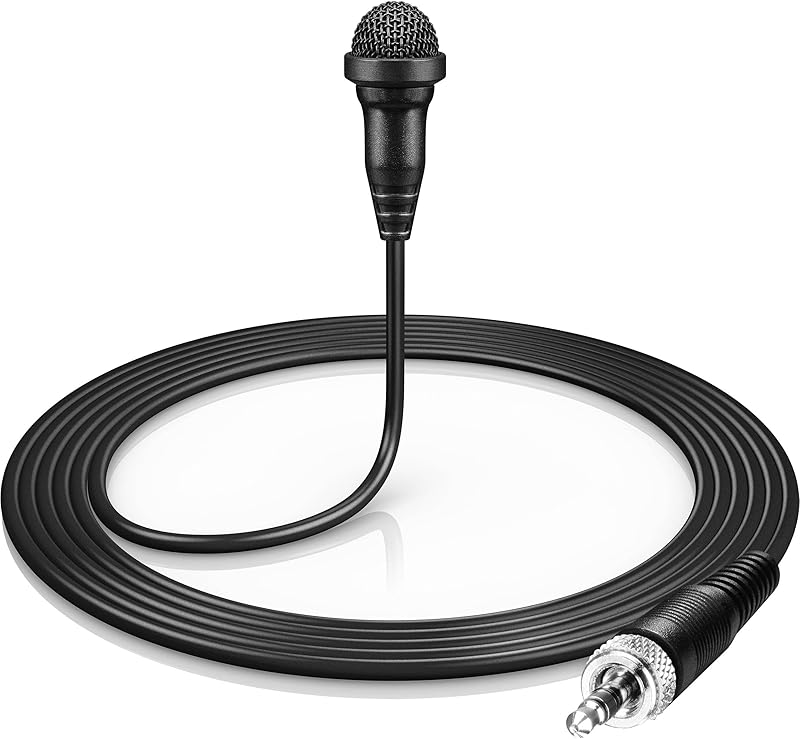
If there’s one thing I have to say about the ME 2-II, it’s that it’s bright. Sennheiser managed to sculpt the upper mids to make them pleasing and smooth without losing any bottom end and offering a loud-and-proud top-end bump that clarifies the voice regardless of the position.
So, my first trial with this microphone was in the center of my chest, clipped on (strong clip, watch out for fancy silk ties). On the good side, the mids are punchy without breaking, the top end opens it up, and there’s no way to make it get muddy. Well, that’s a nice way to describe it: this lavalier microphone sounds clean.
On the not-so-good side, this microphone comes with a fairly high 32 dBa noise floor. I mean, on lavaliers, it’s usually 20 dba, but 32 is a bit too much. Pairing that with the microphone’s kind of weak gain, and you have yourself a problem to work with later on in the mix.
My second test was what I call the tiktoker position, which is hand-holding the mic approximately five inches away from the mouth. I would say this microphone is a little too bright and prone to capture everything around it to be the best ally in your TikTok journey to stardom.
So, I would say for the classic uses of a lavalier microphone, like cinema, presenters, and TV use it’s an outstanding, clear, bright, reliable option. Just beware of the noise floor and the fact that it’s omni and very bright.
Finally, before wrapping it up, I just want to say shame on you, Sennheiser. A plastic bag? Come on! Not even windshield filters?
3. Shure SM63
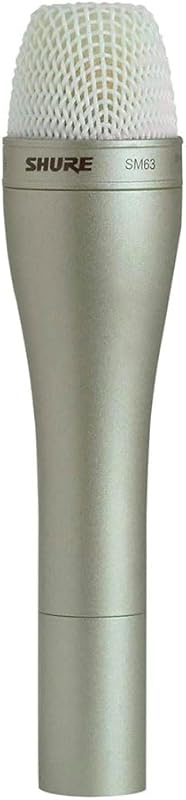
Let me start this by saying two things right off the bat: First, it does feel like they’re joking you when you zip open the leather container. Yes, the SM63 does look like a child’s toy, but it’s a very professional and capable omni microphone.
Second, it’s a shame that dynamic omnidirectional microphones are so under the radar these days; there are a million scenarios when they’re perfect for the job.
Let me start from the beginning, though. As I said, I opened it and was completely unimpressed. It’s underwhelming at first sight, to say the least. Nevertheless, now that I’ve used it, I wish more manufacturers would make them this size; it’s so comfortable!
Also, what comes across as a cheap, plastic grill is actually made of VERAFLEX (yes, I did my homework), and it’s more resistant to falls but also to moisture and consequent corrosion. We’ve all sung through more than a rusty SM58 in our lives, right?
I liked the two built-in protections in this microphone a lot. One is an internal shock-mount for the capsule, so it isolates noises, and the second is a built-in pop filter to get rid of all our lousy plosives.
It works like a charm, doing work like children’s choirs, plays, ambient recordings, and anything that requires moving around while capturing the whole room. For example, it’s great for field recording. It fits in my laptop bag, and it’s all I need to put in front of anything from a full drum kit to an orchestra and get a usable sound.
But above all of that, and this is truly nerdy stuff, this is a dead-quiet microphone. Even if you crank the gain, you won’t get unwanted noises. Believe me, I cranked it for the test and covered my ears in vain. Now, doing my homework, I found out this is because Shure put a humbucker coil inside, capable of keeping hum away, even with studio lights around.
As for sounds, it’s clearly optimized for the human voice. So, everything from group meetings to on-stage speeches, this microphone works perfectly, capturing everything.
In terms of instruments and other field work, there’s a big cut in the low-end and some artificial brightness on the higher mids to give vocal clarity.
Other than that, the response is quite flat, and the results are very usable.
4. Blue Microphones Yeti

The Blue Yeti was at the epicenter of the streaming revolution. They were among the first to offer a new generation of creators the right tools.
This new blackout version of that revolutionary piece of equipment follows the same path.
To begin with, let me say that the Yeti was designed to be on camera. The included desktop stand is very heavy and rugged, and looks cool. Plus, I love that the headphone jack is at the bottom and that it comes with its own monitor volume right in front of you.
The USB is also very handy. I found that not carrying around an audio interface makes everything easier and lighter. Moreover, this is a plug-and-play kind of microphone that’s ready to go straight out of the box.
The Yeti comes with four polar patterns to choose from. These are the typical omni, cardioid, and figure of eight, and a stereo one. This is specifically aimed at ASMR artists.
Now, what I just loved about this mic is how optimized it is for podcasters, streamers, and influencers. I mean, the clarity for vocals is just outstanding. You get a nice high-end with some warmth and a lot of clarity. In that sense, cardioid and figure of eight were great. We tried it with one singer on each side with great results.
In omni mode, it’s a great microphone to put in the middle of the room for group meetings, band rehearsals, and live theater. We even tried it with a guitar trio, and the results were great for the price range.
I have to tell you the bottom end isn’t as round and perfect as on higher-tier microphones, but there’s a lot you can do with it and get usable audio. Don’t expect to capture an acoustic guitar as if you were using a u47 or a u87, but it’ll get the job done.
So, if you’re a streamer, this is the right path for you. Try one today. If you want a do-it-all studio microphone that’s good to take on the road without breaking the bank, then you’d better keep looking.
5. Sony ECMLV1
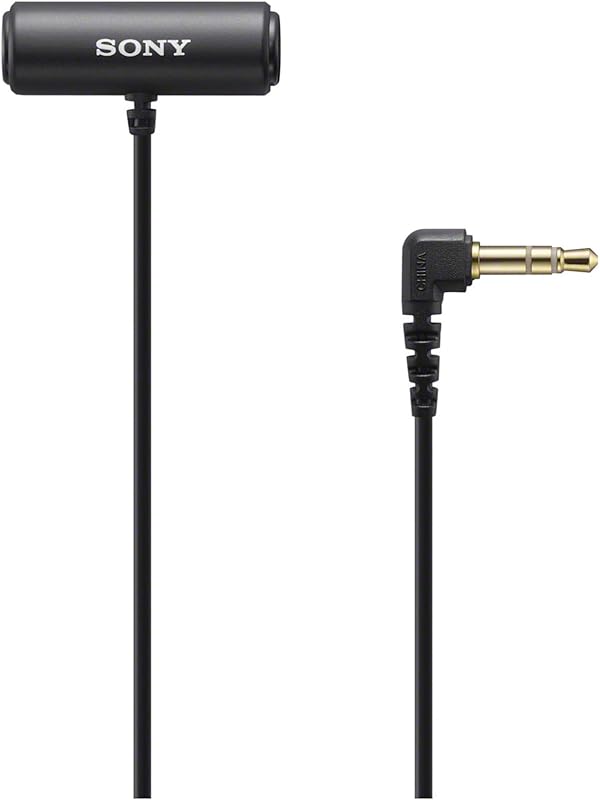
The ECMLV1 is a very tiny microphone that sounds huge and doesn’t break the bank.
Let me start with what I didn’t like so much. The non-detachable cable is just too short. I mean, all you gain with a 360-degree rotating capability and its size, you lose it because of cable length. In the same vein, it doesn’t look sturdy enough to be non-detachable.
Also, the noise floor to work with tends to be a little too much if you have to push it up in the mix later. You’ll pick up some of the ambient noise as well, since noise cancellation isn’t outstanding.
That being said, let me say that there’s a lot I liked about this very inexpensive microphone. The first thing I did, since it comes with an included windshield filter, was take it outside. The microphone gets its power the same way it delivers sound, through the cable. Therefore, all you need is the microphone to do your takes out into the wild.
The result was audio in stereo, which became very handy later on in the mix. Does your client need a stereo track? No worries, you have that problem solved from the start.
Also, I liked the 360-omni pattern because there’s no volume or clarity loss in any of the angles, and, since it can be moved while clipped, you can do a lot to hide it perfectly. Well, the people at Sony decided the front was great for their logo, so it’s not entirely invisible, but it’ll get the job done perfectly.
The EQ curve is optimum for the human voice, and whatever you track speaking will be loud and clear with a gentle bump in the upper range. I tried the tiktoker position with this microphone, but since the cable is so short, you have a hard time even doing a video handholding the tiny mic.
So, to wrap it up, for the price, you get a great lavalier that can get the job done in most scenarios. It doesn’t sound like a hundred-dollar microphone, but it’s clear and tiny.
For those in this tight budget, try it out.
6. Behringer C-3
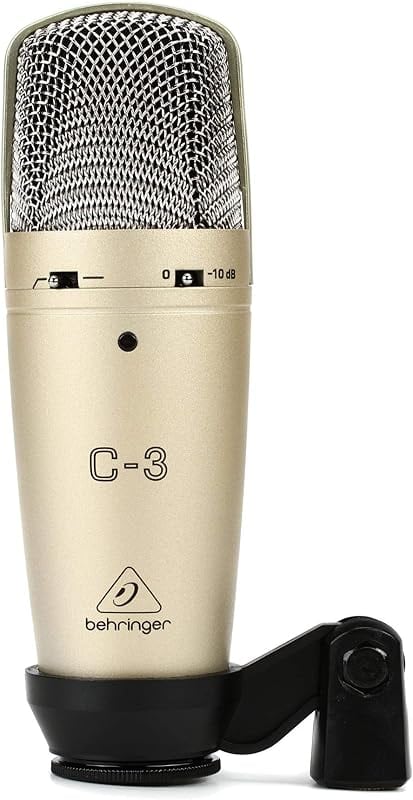
The Behringer and Samson lines of affordable condensers are wonderful. I really mean it. I’ve owned a Samson C-01 (the exact same microphone as the Behringer C-1), and it’s been a workhorse since day one, which was 15 years ago.
The C-3 builds on that concept and delivers a multi-pattern, medium-diaphragm condenser for less than $100. That alone is a great achievement, but the thing is that this line of microphones can even get the job done quite decently in a hobbyist or home-studio environment.
What separates these microphones from professional-oriented gear? Well, above all, the noise floor. Working vocals with a 23dBa noise floor is a very difficult mission, especially with singers when you compress and process them. The noise will take over some of the lower frequencies, and it’ll become a muddy situation.
That said, it’s a great microphone for the hobbyist and the home studio owner. Moreover, I would say that if you are going to have just one microphone to work on all your tracks on everything, this should be it.
In a nutshell, this microphone has a flat-enough response to sound unimpressive but accurate. This translates into clean, usable takes to create music. In that sense, the 10dB pad and the high-pass filter are great to use on everything from a bass cab to an acoustic guitar.
On the omnidirectional pattern, you have to be aware of a gain drop. So, when moving from cardioid to omni, make sure you’re adjusting the gain properly.
In my opinion, this is a great microphone for beginners, hobbyists, and musicians with a home studio who want to get ideas out fast to make song drafts at home.
7. Rode Wireless Micro
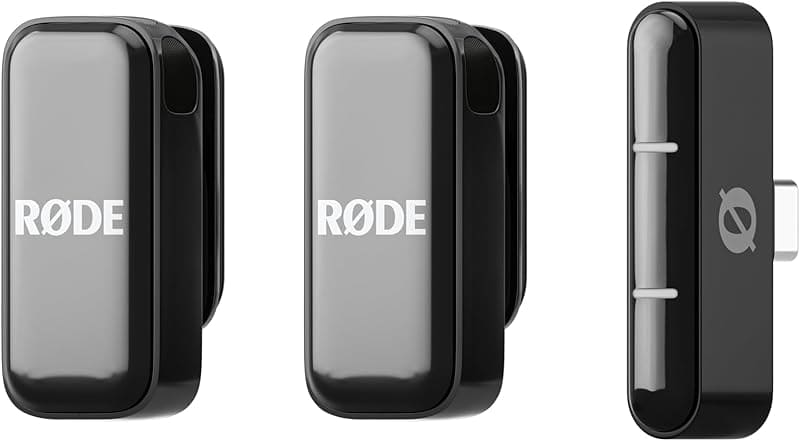
The Rode Wireless Micro is every content creator’s dream. It is a tiny piece of equipment that’s a huge ally in creating videos with top-notch audio quality without the hassle of a studio or bringing many extras to the session.
In fact, what I liked the most about this kit is that it can fit in my pocket. Yes, the small charging case is a bit larger than the case of some AirPods. Plus, it can get the microphones charged for at least three charges before running out of juice.
Speaking of the case and the mic, what I didn’t like was the fact that there’s no room to put the windshields inside. These funky-haircut little things are life-savers, though, if you’re doing videos in a windy scenario.
The sound improves dramatically from that of a regular phone. We did the test of capturing sound in an outdoor spot with the phone, and could hear the cars, planes, and wind while my voice was fighting for its place. With the Rode Wireless Micro, that noise was completely gone. Moreover, with the windshield on, the wind was gone from the mix.
Speaking of sounds, the Rode is powerful, clean, and is specifically aimed at the human voice. Therefore, most of the low-end and lower mids are gone, too. Believe me, echo-filled rooms, high-ceilings, and whatever is prone to give you low-end problems will be defenseless against this microphone’s attack and clarity.
The Rode Wireless Micro is perfect for any content creator looking to up their game for an affordable price, and without carrying more than the phone, the case, and the windshields.
The Bottom End
Omnidirectional microphones can save the day and make your job easier. Whether it is to capture the whole room without many microphones or help you propel your voice and message from your lap, they will surely up your game.
Choose the one from the list that best suits your needs and budget, and start using it today. I guarantee you’ll find many more uses for it once it becomes available as a choice in your arsenal.
Happy (360-degree) recording!
