
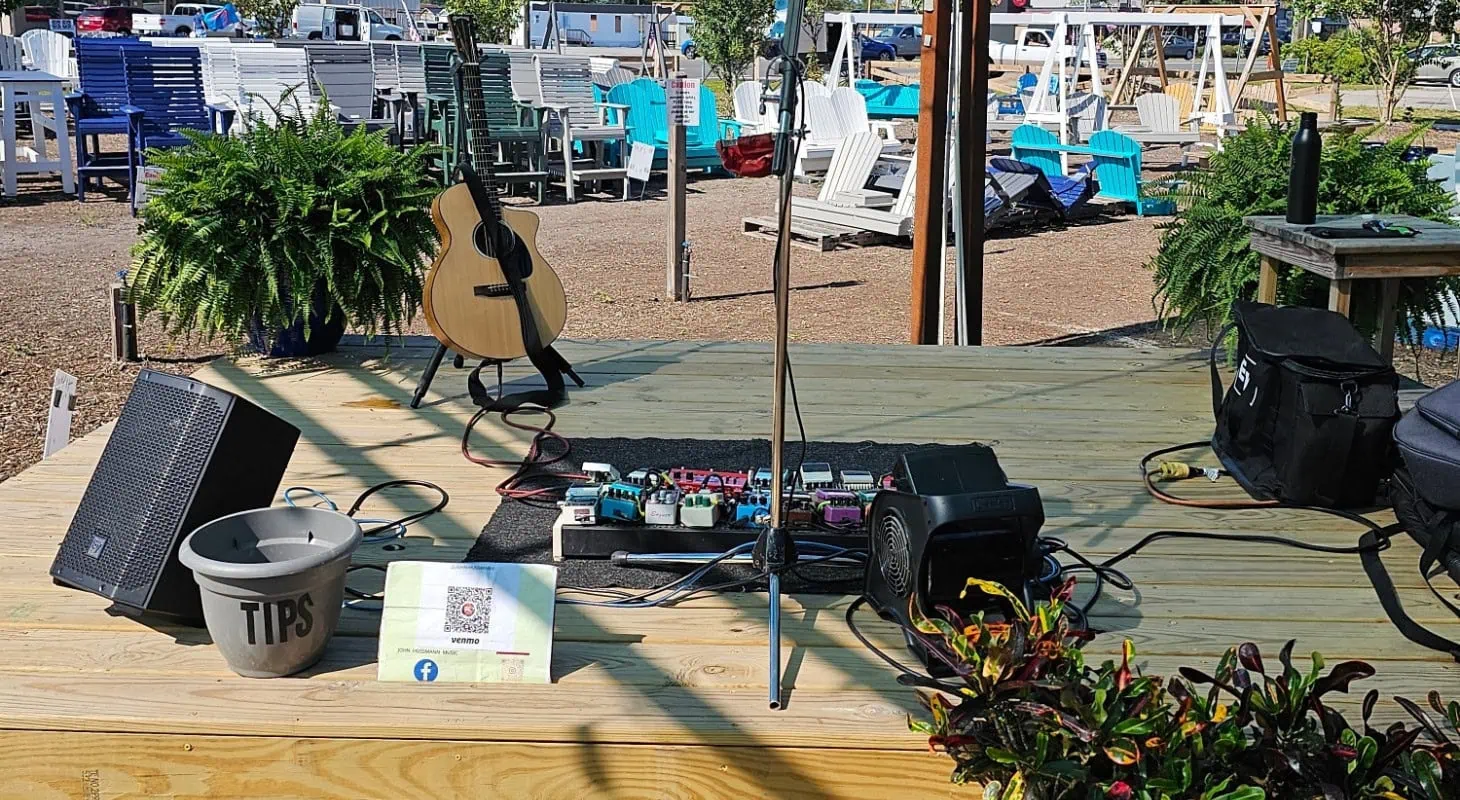
After touring locally for years and finding all sorts of misfits and wrecked equipment in underground venues everywhere, we decided to buy a PA system. Yes, I can proudly say we’re grown-ups playing punk now (lol).
The thing is that, at first glance, it was Mission: Impossible. Options were countless, multiplying by the platform. So, we did the heavy lifting for all of us and handpicked only the best of the best on the market right now.
Top 3 - Powered Speakers for Live Bands
Preview | Product | Price |
|---|---|---|
 | ||
 | ||
 |
This is sharing the benefits of our hard work with you so you can use our map to guide your purchase. Let me tell you, sounding good every gig has been a dream come true.
Oh, and stay until the end to uncover which model we decided to buy and why.
Best Powered Speakers for Live Bands
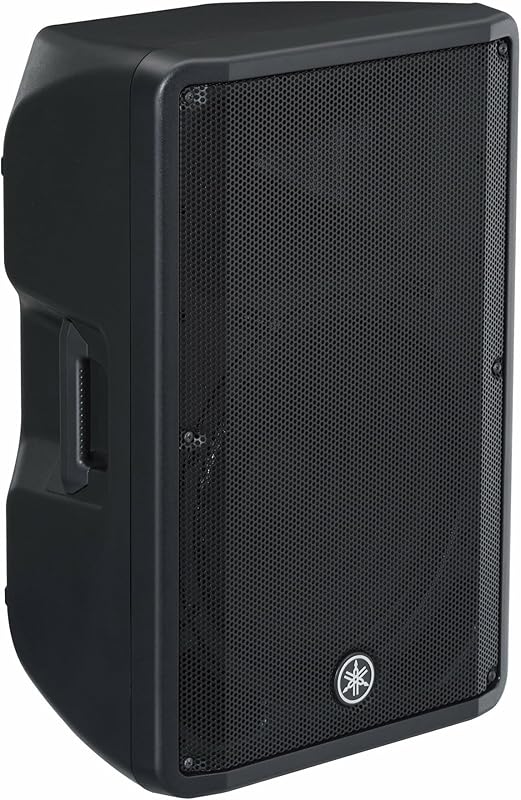
1. Yamaha DBR15
Yamaha is always hard to beat when it comes to price tag vs features. They make everything imaginable with extremely high-quality standards and affordable prices. This is true as long as we don’t talk about high-end pianos or state-of-the-art racing motorbikes.
Now, when it comes to PA systems, they sound great and won’t make a hole in your wallet. What makes this speaker attention-worthy? I’m glad you asked. It’s packed with handy features. For example, I loved the D-Contour switch to use it as a powered monitor and the high-pass filter to use it as a standalone PA for my acoustic solo gigs. I immediately got rid of the boomy bottom end.
Speaking of which, what I didn’t like so much is that this speaker goes down only to 49 Hz. This means some of that low-end from big kick drums felt a bit lacking. Other than that, the clarity we got at the mid and mid-high range was outstanding. I’m talking about crystal-clear vocals and great instrument separation.
Plus, it’s worth noting that the 15” woofer and 1” driver deliver a heavy punch with enough volume at 1000 watts to fill a small venue with sound. In case you think that’s not a lot, the bigger brother of the Yamaha DBR15 is the Yamaha DZR15 with a bulkier price tag but also 2000 watts of unapologetic power ready to go.
If these fit your budget, they’re built like a tank, sound great, and will give you years of sonic joy.

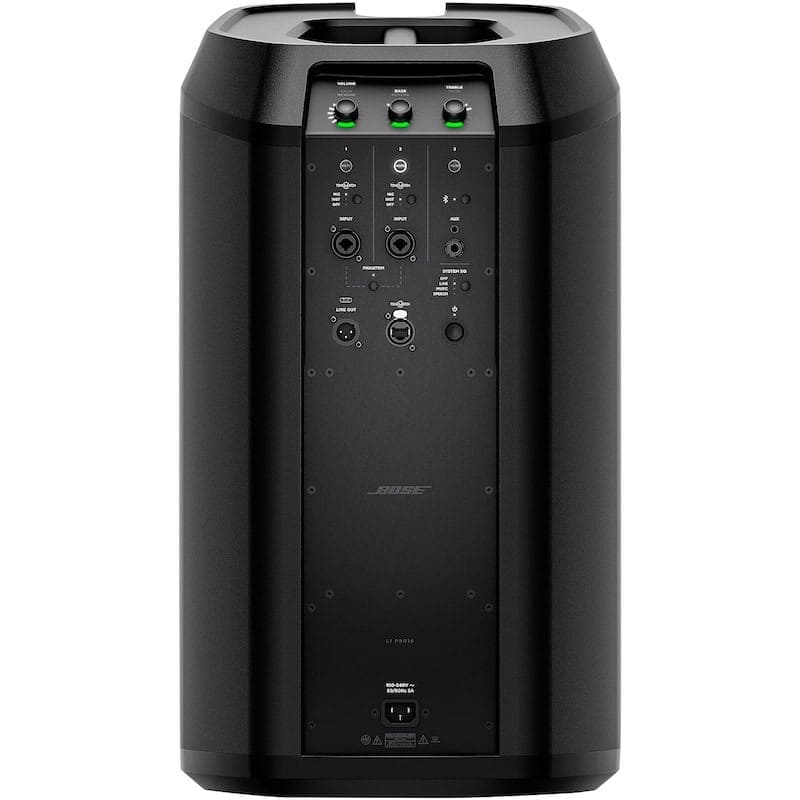
2. Bose L1 Pro16
Yeah, I know what you’re thinking; I was in your shoes once, too. I mean, Bose for real PA audio? No way! That’s a duty-free shop kind of brand. Well, I was hanging out on the beach with some friends, and all of a sudden, a band started playing. They had one of these, and it was loud, proud, and ultra-clear.
It stuck with me, so I went out to try a Bose L1 Pro16 because it’s not cheap, but it sounds gorgeous. It turns out Bose put line array technology in a vertical product.
In my opinion, for small venues and not-so-loud bands, this is a dream come true. We played a couple of reggae tunes, and it was as clear as putting on headphones. That said, for anything a little heavier, we felt it a bit lacking in the low-end.
What I liked the most about this system was its portability. You can arrive at the gig with just a bit of extra weight and solve the PA issue. For example, if you play small venues that don’t need drum amplification, you can just go for it with a single extra bag. Plus, with the app, I was able to walk away from the band and fine-tune our sound while sitting as if I were part of the audience.
Also, we tried linking it to another one at my local music store, and with one on each side, the sky and your neighbors calling the police are the only limits.
On the not-so-good side, the fact that you have one master reverb setting for all inputs is kind of annoying.
Other than that, this is a solid option for those who can live with something not so big in the bottom-end, but that can deliver crystal-clear sound for the rest.
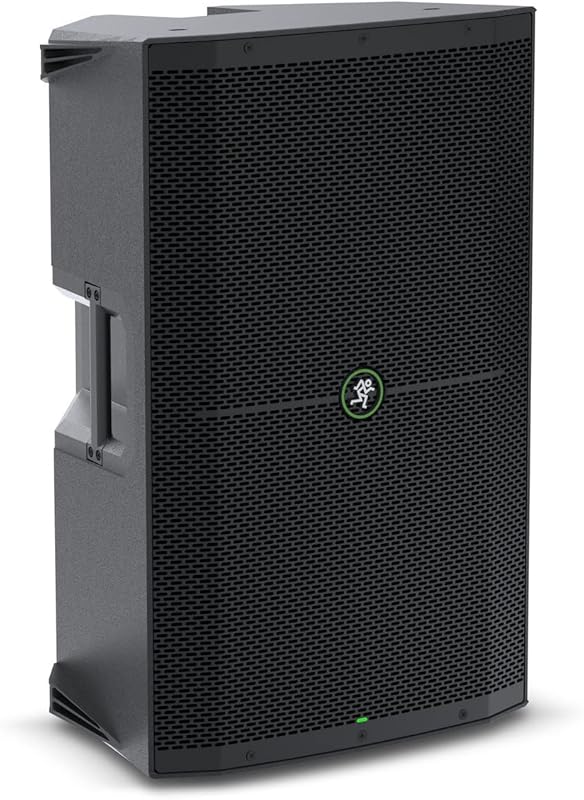
3. Mackie Thump215 XT
For a long-time Mackie user like me, this new iteration of the Thump line makes them way more in-tune with today’s needs. I mean, I can’t imagine any scenario in which you’d fall short with the Mackie Thump215XT.
Right off the bat, there’s an acknowledgement to make; don’t expect Bose-like, crystal-clear midrange and high-end. It’s not as defined and expensive-sounding as those, but it carries way more punch (pun intended) and a low-end that can take a kick drum and amplify it in all its glory.
Although that’s quite something already, these powered speakers hide much more under the hood. To begin with, I loved the different modes that accommodate not only different venues but also different scenarios. I’m talking about the Outdoor mode, which enhances your PA’s capacity to tackle sound dispersion and deliver a tighter sound. In the same vein, the feedback suppressor did wonders for our harmonica/sax player.
To be honest, I didn’t use the voice-ducking feature much, but it might be handy for those who give speeches and need to control that effortlessly.
Finally, the volume in this thing is absolutely fabulous, with great headroom to push the band without any distortion. I have to tell you that, for the price, these are very hard to beat.
Speaking of which, if you want to amplify the band on the go, give the Mackie Thump GO a try; it’s the same technology but battery-powered.
4. JBL EON715
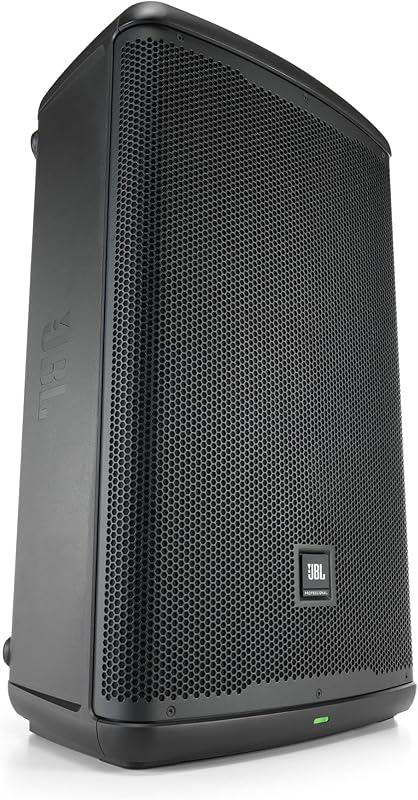
There’s a placebo effect associated with the little orange JBL logo. You know that if you walk into a venue and the backline is JBL, you’ll sound good. Well, this JBL EON715 isn’t an exception to that unwritten rule of mine.
To begin with, this powered speaker is built like a tank. The state-of-the-art JBL technology applied to the enclosure feels sturdy. Plus, we’ve all seen JBL gear take crowd abuse in more than one basement. These things are a legend in reliability.
Now, if you’re a modern person who loves screens, buttons, and apps, this speaker is Disneyland for you. On the other hand, if you’re like me, an old-school man with many years on the road and a love for knobs, you’re in for a steep learning curve.
You get a very sober, streamlined user interface with just two gain knobs, one for each input, and then a big screen with a push button next to it. The good thing about it is that it expands your control over the sound a lot. For example, you can apply an overall or channel-specific parametric EQ, which is great for going deeper into sound-shaping. Coupled with the possibility of walking off the stage and adjusting the levels, that’s an instant hit.
I know what you’re wondering and let me get to it. This thing sounds big and powerful. I tried my Korg MK1 Microkorg through it, and the lows can kick your chest. Moreover, my band’s drummer voted for this model, and when the drummer picks, you know it’s a low-end-oriented choice. They want that chest kick.
Perhaps, the only drawback of this model is that it isn’t the best for old-school people like me who love knobs. If you like working with the app, then try this one, seriously, it might be a winner.
5. QSC K12.2
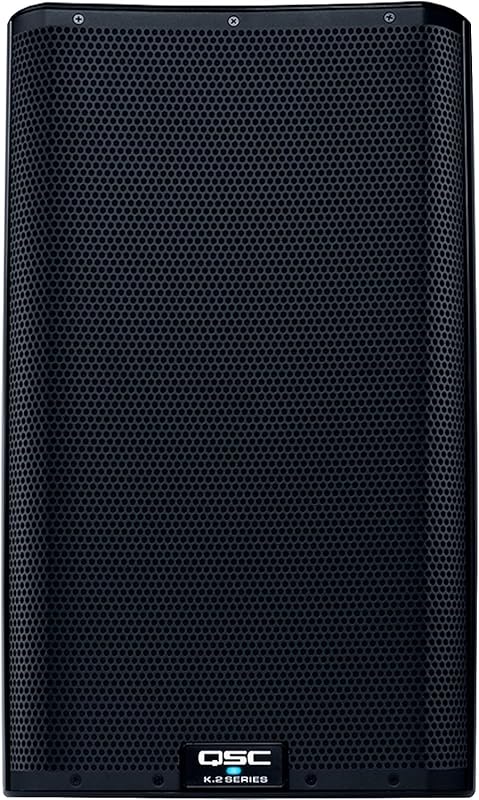
QSC might be the most commonly found power amp brand out there. I’ve come across their products for decades back in the day when the power amp and the speakers were two different things.
Well, this huge brand decided to land in the powered speaker niche in the late nineties. The latest iteration of their creation, the QSC K12.2, is like a fast-forward to the present. They might have arrived 30 years later than the rest, but they carried monster know-how from the power amplifier market.
The first thing I have to say is that these things are LOUD. Their class-D power amp boasts 2000 watts through a 12” speaker and a 1.4” driver. In my opinion, if you play in a big, loud band with a heavy-hitting drummer or a big bottom-end electronic music ensemble, you’ll find the low-end isn’t deep enough with a cut at 45 Hz. Nevertheless, when you push the wattage, the bottom becomes bigger too, so it compensates.
In that regard, the app is great. I mean, we were adding a little delay to the line and doing all kinds of things. We made them into presets, which we called scenes, and could recall at any time.
Yes, this is the model we decided on. We’ve been using them live and they’ve been a bomb. I do miss the low-end of the 15” woofer, but the extra power and the definition of the midrange are too good to pass up. Furthermore, if we arrive at the venue and the PA is decent, these go as floor monitors.
We’ve even used one as a standalone for guitar and vocals with great results. I’m telling you, these things are LOUD.
If your budget allows it, these are great speakers for the gigging musician. Period.
The Bottom End
To us, the decisive quality ended up being a sound we all agreed represented the band most accurately. The QSC model we bought brings out a lively, punchy version of us that we all love. No speaker is perfect, but this is as close as it can be.
Portability and flexibility to fulfill multiple roles became a huge plus, too, while reliability on the road proved we made a good decision.
What’s yours? Get the one that suits you best and get your music out there; we need to hear it loud and proud!
Happy (amplified) playing!
