
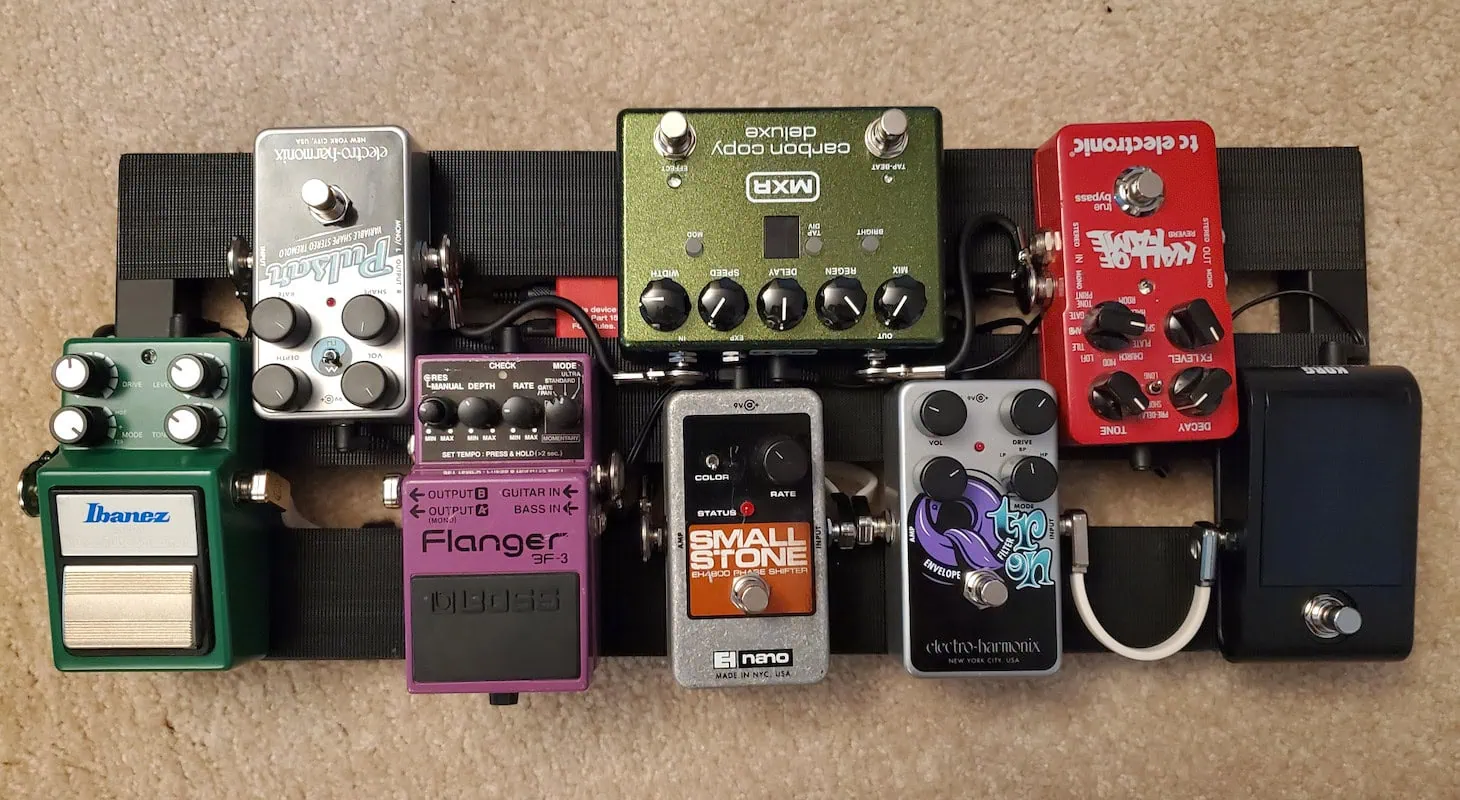
Not quite an auto wah, not quite a modulator. The envelope filter is one of those effects that, after hearing it once, I heard everywhere. Basically, it alters the tone of a note based on picking intensity. I often think they sound like a wah or a phaser, but there’s no shortage of tonal options out there.
They’re more popular than ever, thanks to the development of some truly excellent envelope filter pedals in recent years. With the rise in popularity of disco-influenced pop music, I’m hearing envelope filters live and on record more than ever before.
Top 3 - Envelope Filter Pedals
Here’s a few of my favorites.
Funky Town: 5 Best Envelope Filter Pedals
1. EarthQuaker Devices Spatial Delivery V3
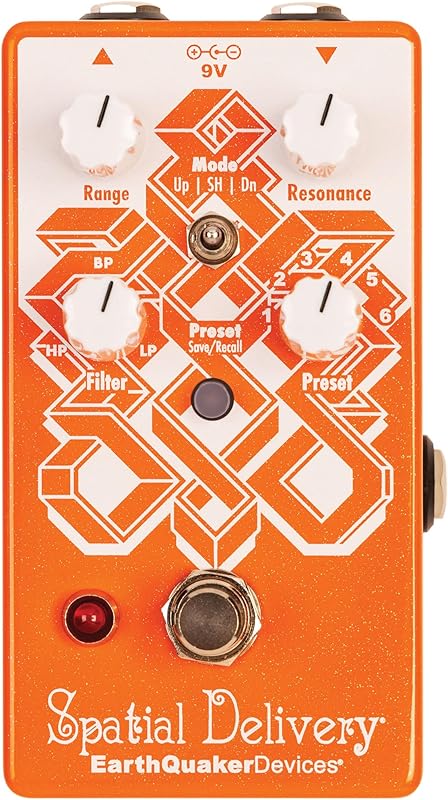
I’ve come to expect to feel like a mad scientist when playing with EarthQuaker pedals. The Spatial Delivery V3 is no exception. It’s loaded with features to the point where it feels like the builders have a crystal ball to foresee guitar players’ wants and needs when it comes to playing with an envelope filter.
First of all, the orange color scheme is particularly eye-catching. I almost mistook it for one of Britain’s most famous amp builders. At about half a pound, it’s reassuringly weighty in my hand, and although the control array appears intimidating at first, it yields a broad range of highly usable sounds more or less immediately.
The basic funk lead envelope filter sounds on offer are awesome. With a little bit of Nile Rodgers-esque compression, it’s pure classic disco tone on tap. The extra controls, however, yield some serious variety: the Sample and Hold feature, for example, offers spacey, psychedelic sounds perfect for a lava lamp and a blacklight. Tweaking the controls offers extra modulation, from deep tremolo to a mild phase.
Of course, with so many useful sounds, one might be forgiven for wondering how to use them live. The Preset switch is profoundly useful here. Once I found a filter tone I liked, I was able to save it to a preset, and return to it whenever I felt like it.
The press and hold feature, too, is a strong selling point. It does have the unfortunate downside of nailing you to a single spot on stage while using it, but it means less awkward toe-tapping around orchestrated parts, so it feels like a worthy trade off.
Overall, it’s a very fun pedal, and one that I can see getting plenty of use for years to come.

2. Source Audio Spectrum Intelligent Filter
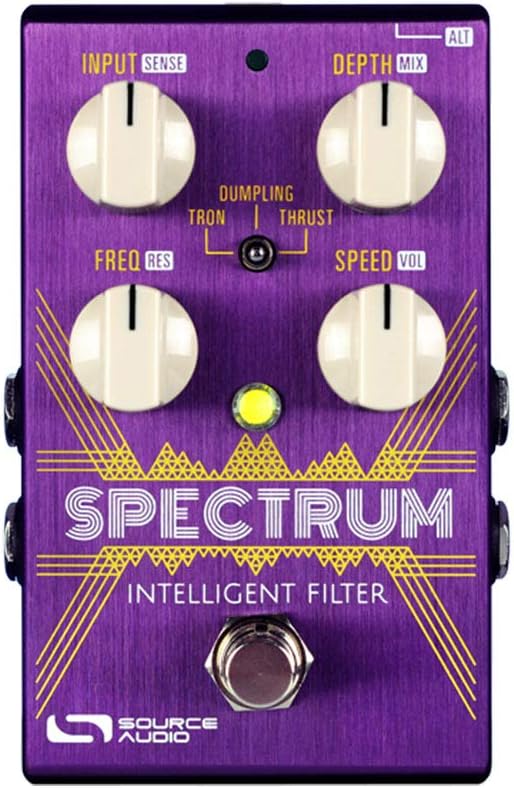
I haven’t seen many purple guitar pedals, so the Source Audio Spectrum really stands out.
Perhaps its purple color scheme is a nod to Prince, “The Purple One,” and his prodigious use of the various effects on offer in this compact little stompbox.
The sounds on offer are all gorgeous, and broad-ranging. I’m particularly taken by the synth-like octave tones, perhaps because they remind me of some of the tastier guitar work from Purple Rain. There’s classic funk tones and swirling, psychedelic tones, too, all contained in the pedal’s already packaged presets.
A curious inclusion here is the ability to adjust the pedal’s picking sensitivity. It effectively gates the effect to react to a certain threshold of picking intensity. I enjoyed it most at its most sensitive, with a wide range of tones springing forth as I adjusted my right hand technique, but I found higher thresholds extremely useful, too.
I have more mixed feelings about the need to use software to tweak the pedal. On one hand, it offers significantly more tonal variation and sculpting. On the other, what if I want to fiddle with the sounds at rehearsal? It feels like too much cognitive load, but I know some players, particularly more modern guitarists raised on modeling software, don’t mind that.
The pedal is sturdy, well-built, and offers remarkable bang for buck in terms of how well it captures a range of envelope filter tones.
3. Electro-Harmonix Nano Q-Tron
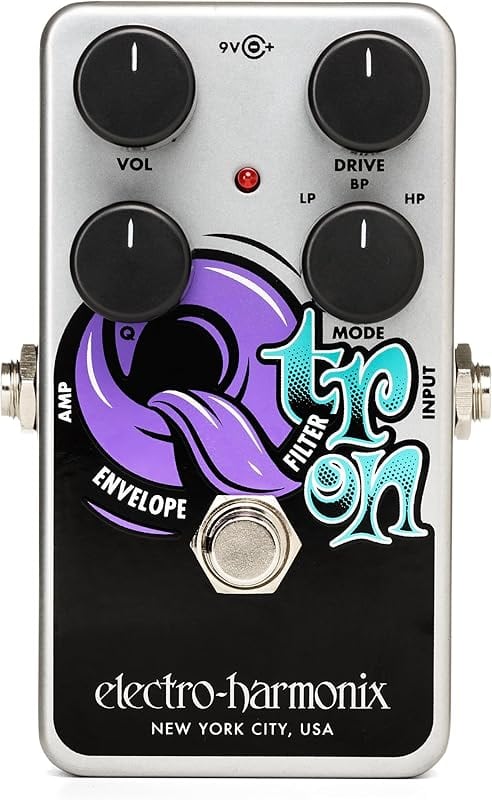
It would be remiss to discuss envelope filter pedals without bringing up the EHX Q-Tron, perhaps the most imitated (and the most varied, if you look at the rest of the EHX lineup) envelope filter effect out there.
The Q-Tron sound here is exactly as advertised: very dynamically sensitive automated wah tones. I’m a fan of the (relatively) simple four-knob layout, and it offers vintage-sounding auto wah. It’s nowhere near as packed with features as more modern envelope filters, but I’d argue that anyone buying a Q-Tron doesn’t want the more modern envelope effects anyway.
The volume knob really helps level things out, rather than just working as a filter gain control. The tones on offer here are all usable, but I will point out that dialling the right sound in took a few minutes of experimentation before I could really just plug and play.
The best sound, in my opinion, is the nicely quacky Low Pass, with the drive control about 3 o’clock, possibly up to 5 o’clock, depending on the output of the guitar. Controlling picking dynamics at this setting opens individual notes up in a truly satisfying range of sounds, and I had a lot of fun with this pedal.
Like the others in the EHX Nano line, the Nano Q-Tron is a Phase 90-sized pedal with a sturdy metal chassis. I personally prefer this pedal sizing to the full-fat Q-Tron+, as it takes up less room on my pedalboard. Gains in terms of pedal size, of course, come with losses in terms of tweakability, but the basic circuitry is the same. Even the Q-Tron Micro takes up more pedalboard real estate than I’d prefer.
The Nano fits much more easily into a standard pedalboard, and does a Q-Tron sound worthy of the Grateful Dead.
4. Behringer B-Tron III
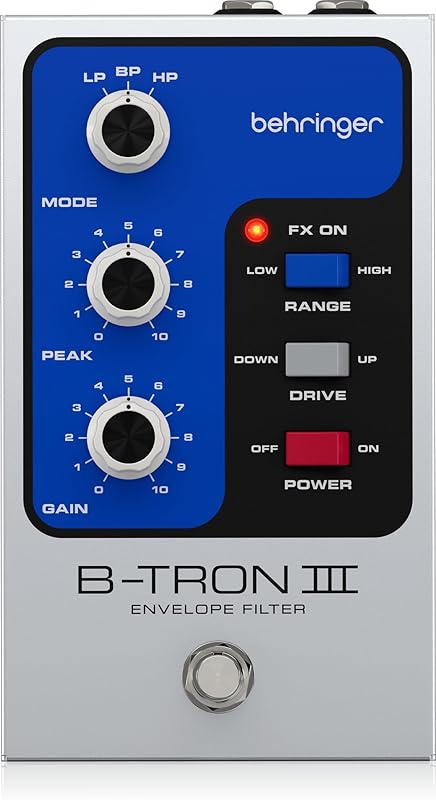
The retro-cool looks of the B-Tron III remind me of Star Wars, which can never be a bad thing!
Perhaps that’s a deliberate choice for this era-accurate reproduction of the 70s envelope filter sound. The tone on offer here is distinctively voice-like, with plenty of shape and attitude to match.
I’d be tempted to call this an instant disco box.
Despite the competitive price tag, the B-Tron feels very sturdy, with a nice metal enclosure. I found the up/down switch very enjoyable: it effectively switches between the toe-down wah position and the heel-down wah position. In other words, the “ah” and “ow” positions. I’d prefer to be able to sweep both, but it’s a cool feature.
It is a little awkwardly sized and shaped for a pedalboard. I feel like most modern pedals come in a range of standard sizes, so this isn’t quite going to fit neatly on many boards. Despite this, it’s not going to take up too much space.
The sensitivity knob is a useful inclusion, too, as it varies the input gain required to trigger the filter. In theory, this makes this a pedal usable with all sorts of instruments, including keyboards, microphones, and, of course, bass guitar. In practice, using a regular six-string electric guitar, it also offers a range of satisfying creative options.
For vintage-voiced envelope filter tones to inspire envy, and at this point, it’s hard to argue with the B-Tron.
5. Keeley Neutrino V2
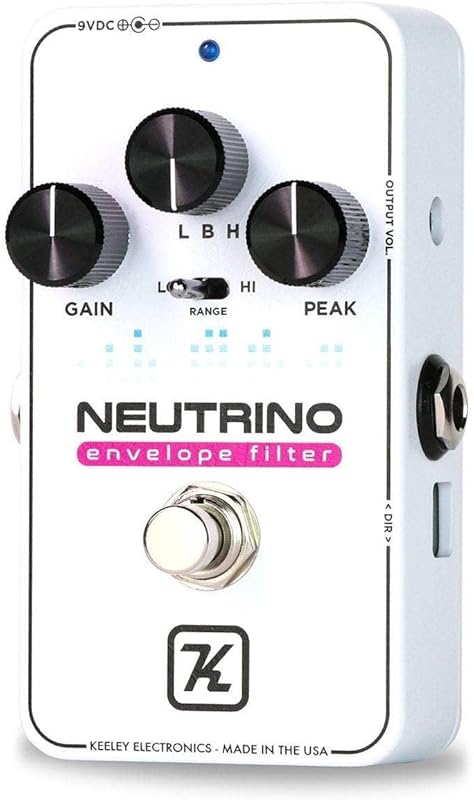
As an avid user of his four-knob compressor, I’m a big fan of Robert Keeley’s work, and the Neutrino is a decidedly cool, extremely usable pedal.
When it comes to envelope filter for electric guitar, most of us think of Jerry Garcia. That’s exactly what Keeley were trying to accomplish here. The relatively stripped-back control array limits the sounds to what I’d call “Jerry-adjacent.” For synth-like sweeps and additional effects, look elsewhere, but this pedal does what it sets out to do.
With all knobs at midnight, out of the box, and played on a Stratocaster, this pedal nails that classic Garcia autowah sound. Nice, quacky, expressive sounds. Not too much distortion or gain.
The control array feels fairly intuitive for those well versed in envelope filters. It’s relatively easy to go open to closed sounds, and it’s easy to increase or decrease the output (with true bypass, it’s worth noting) to counteract any unwanted volume variations in the signal chain.
The pedal is naturally very sensitive to picking sensitivity, so I had to be careful with my right hand technique. Careful technique can only ever be a good thing, but it’s worth pointing out that it will take some getting used to. I’d liken its picking sensitivity to that of an edge-of-breakup tube amp.
It’s nicely funky and quacky, and for a vintage-voiced envelope filter, it’s hard to do much better.
Envelope Filters: More Than Auto Wah
The envelope filter is for many funk and disco players what a compressor is to a country guitarist, or what distortion is to a metalhead. Simply an indispensable part of their guitar rig.
When it comes to envelope filters, the best-known and most-heard pedal is the EHX Q-Tron, which has many clones and many variations, many of which are even made by Electro-Harmonix themselves!
However, more modern envelope filters come complete with broader modulation features, and can mimic phaser, tremolo, octave, and delay sounds with the same basic mechanic: that is, reacting to picking intensity.
As always, it’s always about the individual player’s use case, but the good news is there’s an envelope filter out there for just about any player.
Final Word
Whether you’re looking to recreate Jerry Garcia’s iconic sound, or explore the cerebral, psychedelic soundscapes of funk guitar and bass, it’s hard to get anywhere without a great envelope filter.
The modern market is full of awesome envelope filters, from vintage-voiced goodness to more feature-rich filters worthy of the Purple One himself.
