

Look, I get it. When it comes to guitar pedals, an amp-switching pedal isn’t exactly the most exciting thing in the rig. In this day and age of endless boutique overdrives, modulation effects, and even amp-in-a-box modeling, what’s the fuss about ABY pedals?
Well, eventually, especially for guitar players doing larger shows with a broader variety of tones, you start running more than one amp live. Say one song demands a shimmering Fender clean, and another wants saturated Marshall crunch.
I know plenty of country guitarists, for example, who use both, especially in the modern pop-country scene where guitar tones wildly veer from clean pop sounds to tones more reminiscent of Creed than Creedence.
ABY pedals are very simple, and I’ve compiled a list of my favorites.
Best ABY Pedals – Take Full Control of Your Signal Chain
1. Radial Twin City
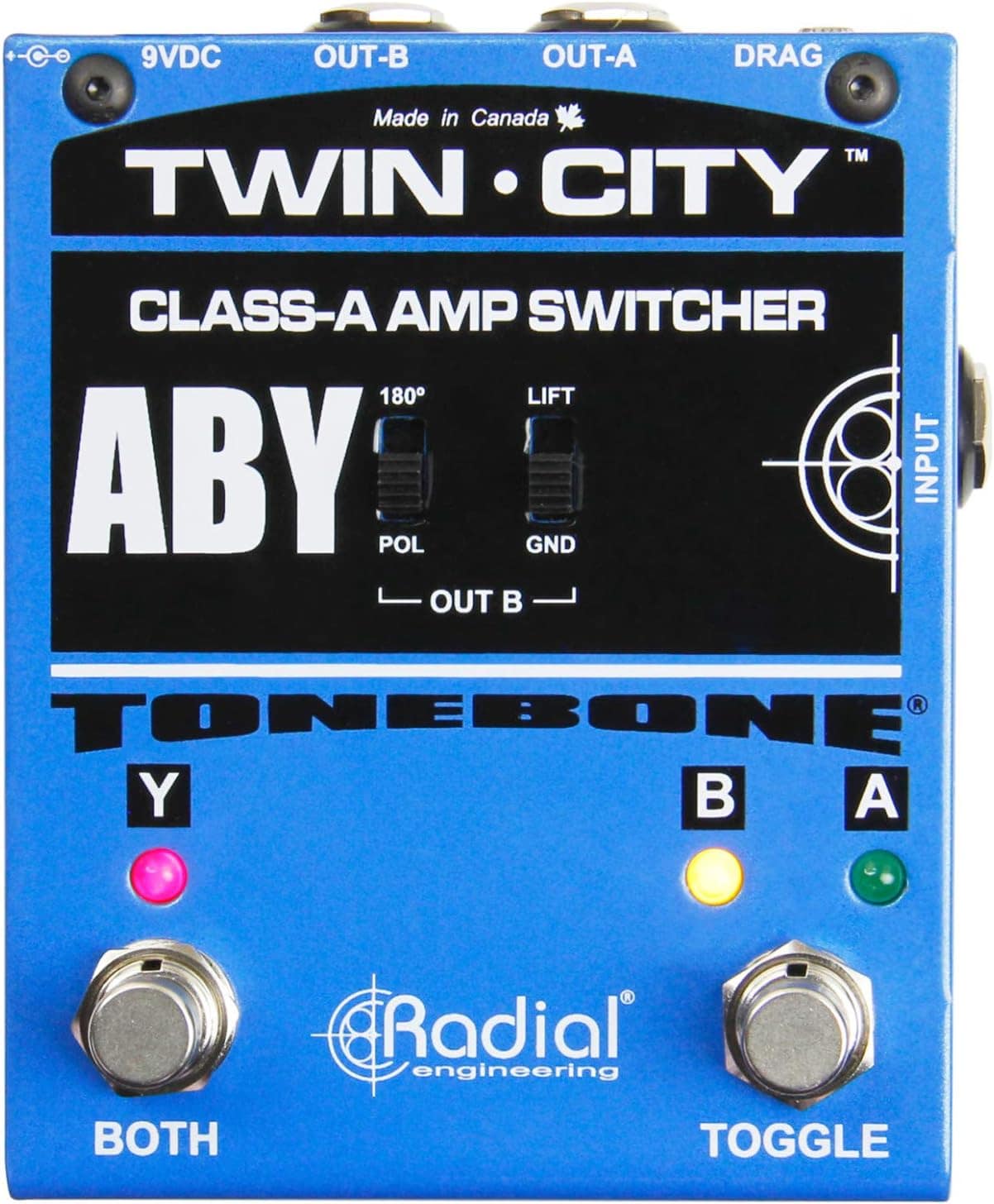
I’ve probably seen the Twin City on more stages than any other ABY. Certainly, it’s the most common ABY at smaller shows.
The main draw here is for guitar players who aren’t interested in running stereo rigs. The Twin City is very much in the same vein as its cousin, the BigShot Amp Switcher.
I’ve used it to run two amps through the same cabinet, switching from one to the other in an instant. Both amps are “loaded” into the cab at the same time, so there’s no risk of burning out my precious tubes, or at least no risk beyond the usual one of playing old amps live.
Once, I was running the Radial at rehearsal with two amplifiers: my Marshall Plexi and my Hughes & Kettner. Instead of a thick, doubled tone, it was thin and pathetic. I learned then what the “reverse polarity” switch does, beyond making me smile and think about Star Trek.
When two amps are running simultaneously with frequencies 180 or 90 degrees out of phase, they “fight” for aural space, canceling one another out. The reverse switch inverts the phase of one of the signals, resolving this issue, and endowing the dual-amp setup with its full intended power.
The Twin City is compact, so it’s easy to travel with, it doesn’t buzz, hum, or crackle, and it offers the chance to run A, B, or AB for maximum tonal variation. The Ground Lift switch on this pedal really helps out in alleviating unwanted noise, especially in larger high-gain rigs.
Overall, a great option.
2. Morley Gold ABY
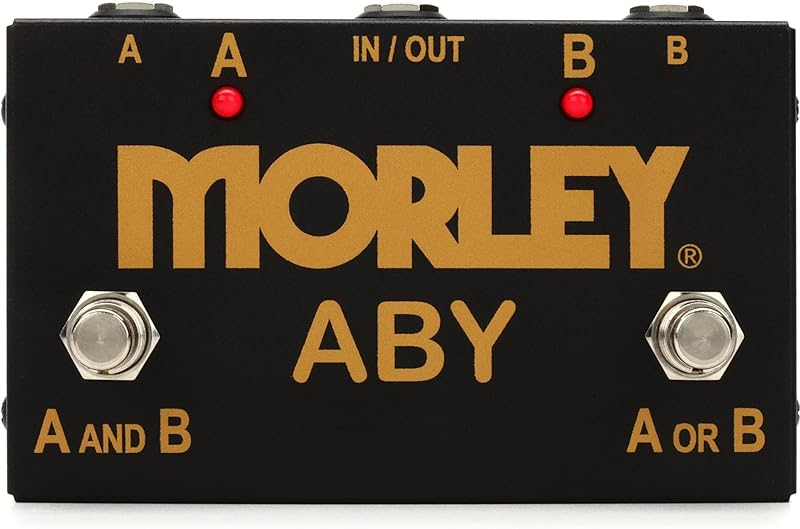
I didn’t realize Morley made more than wah pedals! The Gold ABY does draw, to my eye, from the design principles of the infamous Morley wah: it’s rugged, affordable, and clearly built to last.
The steel housing is reassuringly heavy in my hand, and the competitive price makes me feel like I can take it on the road without worrying about losing or damaging it. In fact, at this price point, I could buy two Morley ABYs and have one as a spare, and still end up at about the same outgoing cost as some other ABYs!
The functionality here is brutally simple, with A, B, and AB switching on offer. Its stereo output is inspiringly clean and noise-free, allowing me to roam the stage freely enveloped in my guitar’s sound. If only I played stages big enough to do that all the time!
Another notable use here is the option to run two inputs to one output. That is, I can leave a spare guitar already plugged in on stage, and easily switch between instruments, without unplugging or plugging anything. With electric guitar gigs, I often have to go from standard to Drop D on the fly, or even all the way down to D standard. With the Morley, I don’t have to stand there awkwardly retuning my guitar between songs.
The bright LED lights feel like they would be visible from space, so they’re more than adequate for a dark club stage.
It’s hard to argue with the dual functionality of a splitter-combiner, and it’s hard to argue against this competitive price point.
3. Boss LS-2 Line Selector
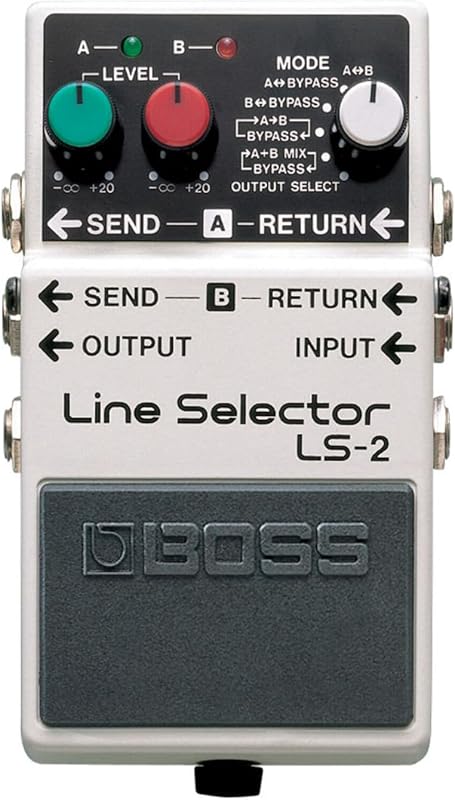
My soft spot for Boss pedals is well-documented at this point. The brutalist simplicity of their pedal design (if not always for the pedal functionality) will always have a place in my heart. It’s something about the affordability of their main line and their ubiquitous presence on boards from high schools to stadiums.
Regardless, the LS-2 Line Selector isn’t exactly an ABY pedal. It can fulfil an ABY function, but it’s really a more complicated beast than that.
At first glance, the pedal is classic Boss. The bypass functionality is clean, as expected. The housing is appropriately tank-like for the brand. There’s even one of my favorite Boss Easter egg features, as shared by the TU-3 tuner: the LS-2 can supply 9V DC power to other pedals on the board!
The controls are a little staggering for those of us used to the bare-bones layout of other Boss pedals. Simple A and B volume knobs, conveniently color-coded. The “Mode” knob is another beast entirely, offering switching and combining functions.
I used the LS-2 for a few applications: one was to effectively, with some adept pedal wiring, turn my single-channel Marshall into a multi-channel amp. Loop A being the “clean” channel, at lower volume with some tasteful compression. Loop B is the dirty channel, with an overdrive stack of a few key pedals and more volume.
Of course, it’s easy enough to run the pedal to switch between two amps, or to use one amp as a rhythm tone and add the other for a lead boost.
In a way, despite being a relatively user-friendly Boss pedal, this feels a bit like the Strymon of ABY pedals, offering an extremely broad range of options. It feels a little like overkill at times, but no time spent playing guitar and chasing tones is ever wasted, in my opinion.
4. JHS ABY Active A/B/Y Switch Pedal
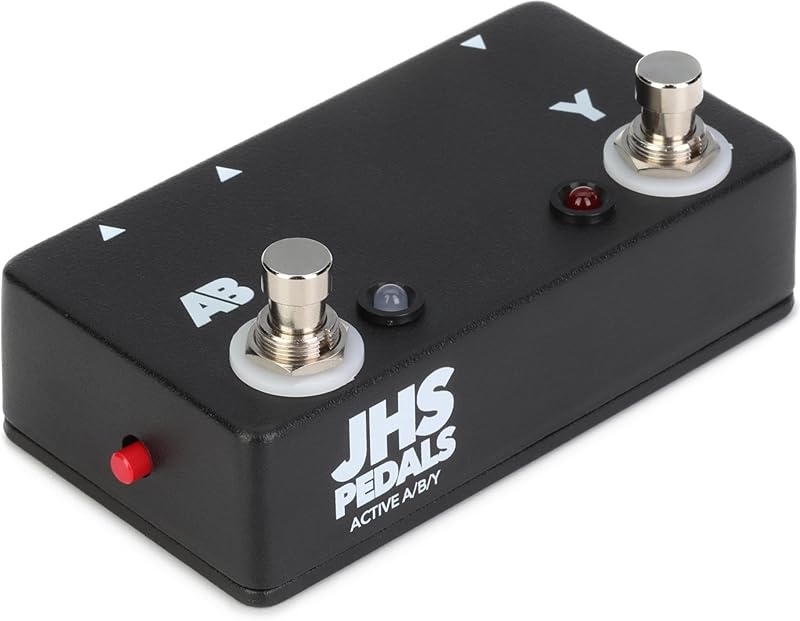
I’ve come to expect simple, no-frills pedals from JHS, and this ABY absolutely lives up to that reputation. Even the minimalist black housing seems to shout “this pedal does as described, and no more.” I like that kind of confidence in a guitar brand, and I like the JHS ABY Active Switch Pedal.
First of all, there’s no audible click or pop when switching channels or pressing on the foot switch. JHS attributes this to FET transistors. The A, B, and AB signals are all pristine and uncompromised.
The build quality here isn’t quite as rugged and durable as I’d prefer. I like my pedals to feel like they could take a beating. Ideally, I’d like them to feel like they could give a beating, perhaps to a particularly surly bass player.
The JHS housing feels flimsier than, say, a Boss or MXR pedal. Similarly, the reverse polarity switch isn’t flush in its hole, drifting a little within the spot. It doesn’t always catch, either, demanding a few extra presses. I wound up using the end of the miniature screwdriver I keep in my guitar case to press it down. That’s not exactly ideal for on-the-fly feedback elimination, or managing onstage tonal combat between two similarly-voiced amps.
The twin LEDs are nice and bright. It’ll happily take a standard 9 volt power supply, and it really doesn’t demand the use of a manual. One switch chooses between lines, the other turns both on.
For simplicity, it’s a winner, but I’d worry about the rigors of touring with this pedal. The JHS ABY is a great option for bedroom players or those who gig only once or twice a month, however.
5. Orange Amp Detonator
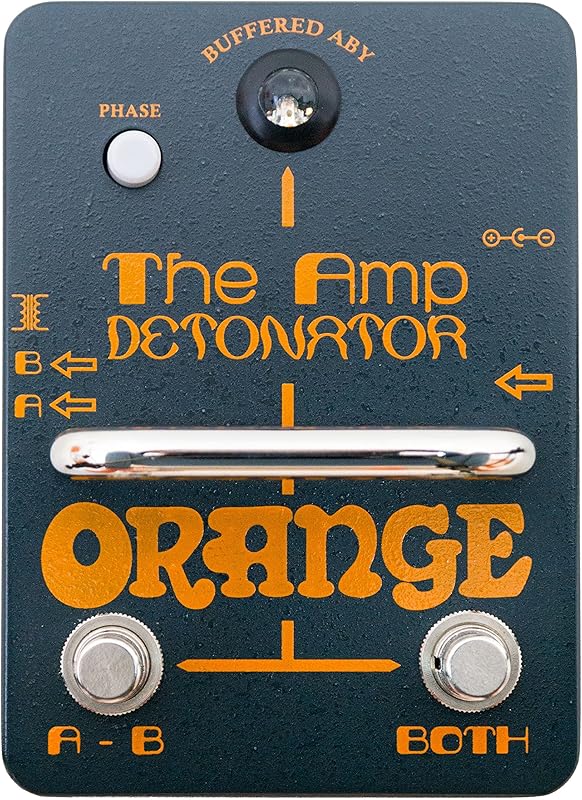
Amp Detonator is officially the coolest name for a pedal I’ve ever seen.
The prestige of the Orange brand means I expect a lot from their pedal offerings. Like their amplifiers, the Orange Amp Detonator looks very cool. There’s a clear nod to post-war British pop art stylings here. The mostly-black housing with orange writing evokes memories of the Terry’s chocolate orange, but I digress.
The usability here is very high. Simple switch layout, and the pedal’s girthier than, say, a Boss pedal, but it means that I won’t accidentally press the wrong switch, even in my size 11 boots.
The switching here is silent as a church mouse. I imagine the Orange brand and appearance here would appeal to doom and fuzz players in particular, and that’s a good thing: the buffered output handled even my longest cables and pedal runs with great aplomb.
The polarity switch is appropriately silent and did help balance out some thinner tones when necessary.
Best of all, and unlike most other ABYs, the Amp Detonator takes a 9 volt battery! I’ve played many small venues with inadequate power sources: the one plug on stage has to power all the band’s amps, and sometimes you run out of sockets for your pedals.
I tend to keep a few square batteries spare in my guitar case, and it’s great to have the option of map switching even if there’s no available power source for my pedalboard.
6. Donner ABY Box Line Selector
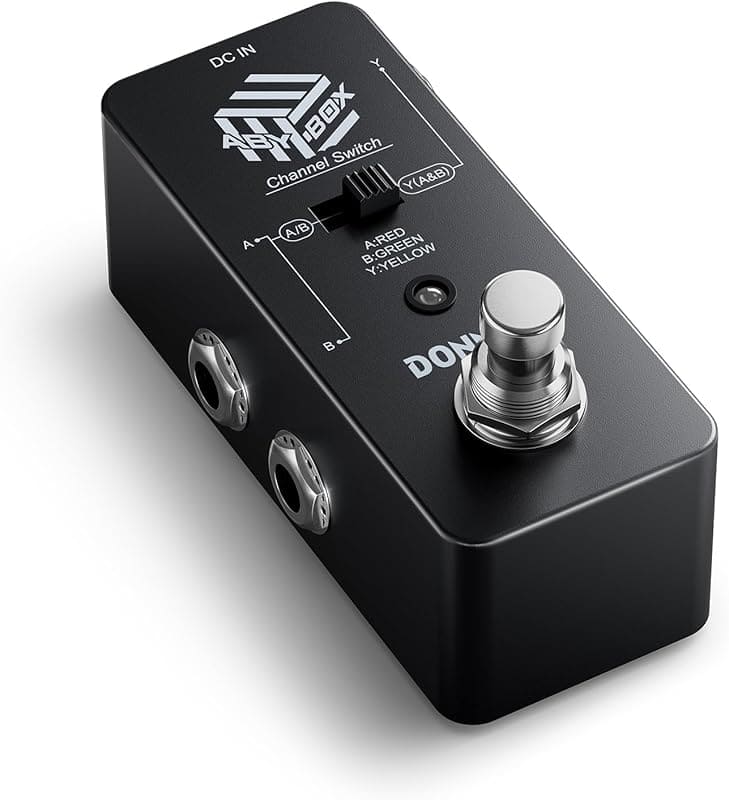
Donner isn’t exactly a major player in the amp game, but for those of us looking to dip our toes in the market, it’s hard to argue with their prices. Donner’s ABY line selector is a mini pedal, so it won’t take up much room. I’m surprised it can accommodate three ¼ inch jacks!
The metal shell is comfortingly dense, and the tone coming out of the pedal is nice and clear.
Overall, it’s a fairly user-friendly experience, although I did find the miniscule switches to be a little difficult to navigate. It only takes DC power, so there’s no battery backup, and there are no extra features here like providing power to other pedals.
The multi-color LED is a cool feature, and the single switch demands cycling through all three options.
As a result, I’m reluctant to use the pedal live, as I’m unable to choose A, B, or AB at any moment.
I can see myself using this as an affordable, portable backup to a bigger pedal with more features. At this size, and this price point, it’s easy enough to pack two of these Donner pedals into a guitar case neck compartment and have them available as backups.
Why ABY?
The point of an ABY pedal is very straightforward. It takes the single signal from your guitar and splits it into two signals.
That’s it. These split signals can then be sent to different inputs, usually different amplifiers. A friend of mine (read: the drummer) once asked what “ABY” stands for.
In reality, it describes the pedal’s purpose. There’s an “A” channel, a “B” channel, and the “Y” indicates the forking of the guitar signal.
In an ideal use case, the ABY offers unparalleled tonal versatility. It offers the chance to use multiple amps simultaneously, or to switch between them on the fly. John Mayer and Tool’s Adam Jones use this method live, for example.
I also like to use an ABY pedal to create a “stereo” effect live, with one amp stage left and the other stage right, creating a more immersive, three-dimensional effect.
Modern effects pedals often feature a stereo output, including stereo delay, with each trail “bouncing” from one amp to the other. When I’ve tried this, it always reminds me of the awe-inspiring experience of seeing U2 live.
How to Choose an ABY Pedal
My priorities for ABY pedals are quality of tone, durability, and user friendliness. I want the signal coming out of the ABY pedal to be totally uncompromised or colored by the unit. Likewise, I like my gear to be reliable, able to withstand the two hundred gigs I tend to do per year. Finally, I prefer plugging in and playing, not spending hours tweaking sounds and knobs.
Final Thoughts
ABY pedals are kind of like buying a guitar case or a stand. For gigging with multiple amps, they’re a necessary, if a little unexciting, purchase. However, I’ve found that there’s hours of joy to be had in experimenting with different amp and pedal layouts, and the ease of switching from, say, a cranked Marshall tone to a shimmering, clean Fender sound live on stage should bring a smile to any serious guitarist’s face. I know it does for me.
